Comprehensive Revenue Cycle Management for Healthcare Organizations
Strengthen Your Revenue Cycle From
Patient Intake to Payment
Every patient encounter creates a financial process that begins before the visit and continues until the provider receives appropriate reimbursement.
Healthcare Revenues provides comprehensive Revenue Cycle Management (RCM) services designed to help healthcare organizations manage this process more effectively.
From patient registration and insurance eligibility verification to charge capture, medical billing, claims management, payment posting, denial management, and A/R follow-up, our team supports the critical stages that influence your practice’s financial performance.
Our goal is simple: help you capture more of the revenue you have already earned while reducing avoidable delays, errors, and administrative burden.
Revenue Cycle Management is the process of managing the financial lifecycle of a healthcare encounter — from the patient’s initial registration and insurance verification through claim submission, reimbursement, and final payment.
A complete revenue cycle can involve:
Patient registration
Insurance eligibility and benefits verification
Authorization and referral processes
Charge capture
Medical coding
Claim preparation
Claim submission
Payment posting
Denial management
A/R follow-up
Patient collections
Financial reporting
Effective RCM connects these activities into one coordinated workflow rather than treating medical billing as an isolated task.
The Healthcare Financial Management Association describes RCM as the process of tracking revenue from the patient’s initial encounter through final payment, including registration, benefits verification, care delivery, claim submission, reimbursement, and communication with payers and patients.
Why Revenue Cycle Management Matters
Your Revenue Cycle Affects More Than Billing
A healthcare organization’s financial performance can be affected by problems that occur long before a claim reaches the payer.
Incorrect patient information, inactive insurance coverage, missed charges, coding issues, claim errors, delayed submissions, unresolved denials, and ineffective A/R follow-up can all create unnecessary revenue delays.
Healthcare Revenues takes an end-to-end approach to RCM so potential problems can be addressed at the appropriate stage of the revenue cycle.
A Strong RCM Process Can Help You:
Improve claim accuracy
Reduce avoidable claim rejections
Identify and address denials
Improve payment turnaround
Reduce outstanding A/R
Strengthen patient financial workflows
Improve revenue visibility
Reduce administrative workload
Identify revenue leakage
Support more consistent financial performance
The objective is not simply to submit more claims. It is to create a revenue cycle in which clean information enters the process, claims move efficiently, payments are posted accurately, and outstanding balances receive timely follow-up.
End-to-End RCM Support for Your Practice
Our Revenue Cycle Management Services
Healthcare Revenues provides a comprehensive range of RCM services designed around the operational needs of healthcare providers.
Our services can be customized according to your specialty, practice size, payer mix, workflow, technology environment, and existing billing operations.
Patient Registration & Demographic Management
Accurate patient information forms the foundation of a streamlined revenue cycle. We manage essential data, including demographics, insurance details, coverage information, and billing fields upfront to prevent downstream claim delays.
Eligibility & Benefits Verification
Confirming active coverage prior to appointments minimizes financial risks. We handle eligibility checks, benefits verification, coverage reviews, policy validations, and patient responsibility estimates to prevent claim denials.
Charge Entry & Charge Capture
Accurate charge capture ensures all clinical encounters translate into billable services. Our team focuses on entry precision, complete encounter details, timely processing, and workflow coordination to eliminate revenue leakage.
Medical Coding Support
Medical coding connects detailed clinical documentation with accurate billing codes. We support CPT, HCPCS, ICD-10-CM, modifiers, and diagnosis coding to ensure claims strictly align with standard CMS processing guidelines.
Medical Billing Services
Our medical billing services streamline the preparation, validation, and submission of claims. We handle electronic submissions, status tracking, billing corrections, rebilling, and direct payer management for timely payment.
Claim Submission & Claim Management
Managing claims requires continuous tracking throughout their lifecycle. We assist with validation, electronic submissions, rejection management, status checks, corrected filings, and active reviews to minimize payment delays.
Denial Management
Unresolved denied claims delay reimbursement and increase administrative burdens. We analyze denial causes, perform coding reviews, handle corrected filings, and submit appeals to prevent recurring denial patterns over time.
Payment Posting
Accurate payment posting offers complete visibility into payments, write-offs, and balances. We process insurance payments, patient balances, ERA/EOB reviews, and adjustments to maintain reliable accounts receivable records.
Accounts Receivable Management
Outstanding accounts receivable require structured follow-up to recover revenue. We analyze A/R aging, follow up with insurance payers, investigate underpayments, and prioritize aging balances for swift account resolution.
Old A/R Cleanup
Aged A/R balances often represent lost revenue caused by old denials or billing errors. We review aging accounts, re-examine documentation, identify appeal opportunities, and resolve balances to restore cash flow.
Reporting & Compliance
Clear performance visibility drives effective long-term financial management. We deliver structured reports covering A/R aging, denial trends, collection performance, and key metrics to correct issues before they impact revenue.
Reporting & Compliance
Clear performance visibility drives effective long-term financial management. We deliver structured reports covering A/R aging, denial trends, collection performance, and key metrics to correct issues before they impact revenue.
Our RCM Process
A Structured Approach to Revenue Cycle Management
Every healthcare organization has different workflows, payer relationships, specialties, and operational challenges. Our RCM process is designed to provide a clear framework while allowing flexibility around your existing operations.
Assess
We review your existing revenue cycle, workflows, billing processes, payer mix, A/R, denial patterns, and operational challenges.
Identify
We identify potential revenue leakage, workflow gaps, billing issues, A/R problems, and areas that may be slowing reimbursement.
Plan
We establish priorities based on your organization’s needs and develop an appropriate RCM workflow.
Execute
Our team supports the applicable billing, claims, payment, denial, and A/R processes.
Monitor
We monitor relevant performance indicators and identify emerging issues.
Report
We provide reporting and insights to help you understand what is happening across your revenue cycle.
Improve
We use performance information and recurring issues to identify opportunities for process improvement.
Front-End and Back-End RCM
Managing the Entire Revenue Cycle
Effective RCM requires attention to both the front end and back end of the revenue cycle.
Front-End Revenue Cycle
Front-end activities take place before and around the patient encounter.
These may include:
Patient registration
Demographic verification
Insurance verification
Benefits verification
Authorization
Referral management
Patient financial information
Charge capture
Problems at this stage can follow a claim throughout the rest of the billing process.
Back-End Revenue Cycle
Back-end activities occur after services have been provided and claims have entered the billing process. These may include:
Claim submission
Claim status follow-up
Payment posting
Denial management
Appeals
A/R follow-up
Patient collections
Account resolution
Financial reporting
Healthcare Revenues helps connect both sides of the cycle instead of focusing on claims alone.
Identify Problems Before They Become Revenue Problems
Healthcare organizations may experience revenue cycle challenges such as:
Insurance Eligibility Issues
Inactive or incorrect insurance information can create avoidable billing problems.
Missing or Incomplete Charges
Services that are not captured correctly can result in lost or delayed revenue.
Coding and Documentation Issues
Inaccurate or incomplete coding and documentation can affect claim processing and reimbursement.
Claim Rejections
Claims that fail initial payer or clearinghouse requirements may require correction and resubmission.
Claim Denials
Denied claims require investigation, appropriate correction, and timely follow-up.
Slow A/R Follow-Up
Unworked or aging accounts can remain outstanding for extended periods.
Payment Posting Errors
Incorrect posting can make A/R balances and financial reporting unreliable.
Lack of Visibility
Without consistent reporting, it can be difficult to determine where revenue is being delayed or lost.
Benefits of Outsourced RCM Services
Give Your Practice More Control Over Its Revenue Cycle
Reduce Administrative Workload
Your clinical and administrative teams can spend less time managing repetitive billing and follow-up activities.
Improve Revenue Cycle Visibility
Structured reporting can provide a clearer view of claims, payments, denials, and outstanding A/R.
Strengthen Denial Management
A consistent denial management process can help identify recurring issues and address them more systematically.
Improve A/R Follow-Up
Dedicated follow-up can help keep outstanding accounts from being overlooked.
Support Faster Issue Resolution
Identifying problems earlier can reduce unnecessary delays throughout the revenue cycle.
Scale With Your Practice
An outsourced RCM model can provide additional support as patient volume, providers, locations, or services expand.
RCM for Different Healthcare Organizations
Revenue Cycle Management Built Around Your Organization
Healthcare Revenues supports a range of healthcare organizations with different operational and financial requirements. Our RCM services can support:
Healthcare Practices
Helping physician practices manage billing, claims, payments, denials, and A/R.
Specialty Practices
Supporting specialty-specific billing and revenue cycle workflows.
Clinics and Medical Centers
Helping multi-provider organizations coordinate revenue cycle activities across their operations.
Hospitals and Healthcare Systems
Supporting complex revenue cycle processes across larger healthcare environments.
Specialty-Specific Revenue Cycle Management
RCM That Understands Your Specialty
Revenue cycle requirements can vary significantly between medical specialties. Different specialties may involve different:
CPT and HCPCS codes
Documentation requirements
Payer policies
Authorization requirements
Billing workflows
Claim patterns
Denial risks
Patient populations
Healthcare Revenues provides RCM support for a broad range of specialties, including:
Cardiology
Orthopedics
Pediatrics
Internal Medicine
Dermatology
Neurology
Gastroenterology
Psychiatry
Podiatry
OB/GYN
Urology
Ophthalmology
Behavioral Health
Pain Management
Physical Therapy
Occupational Therapy
Radiology
Anesthesiology
Oncology
Endocrinology
Primary Care
RCM and MIPS
Connect Financial Operations With Quality Performance
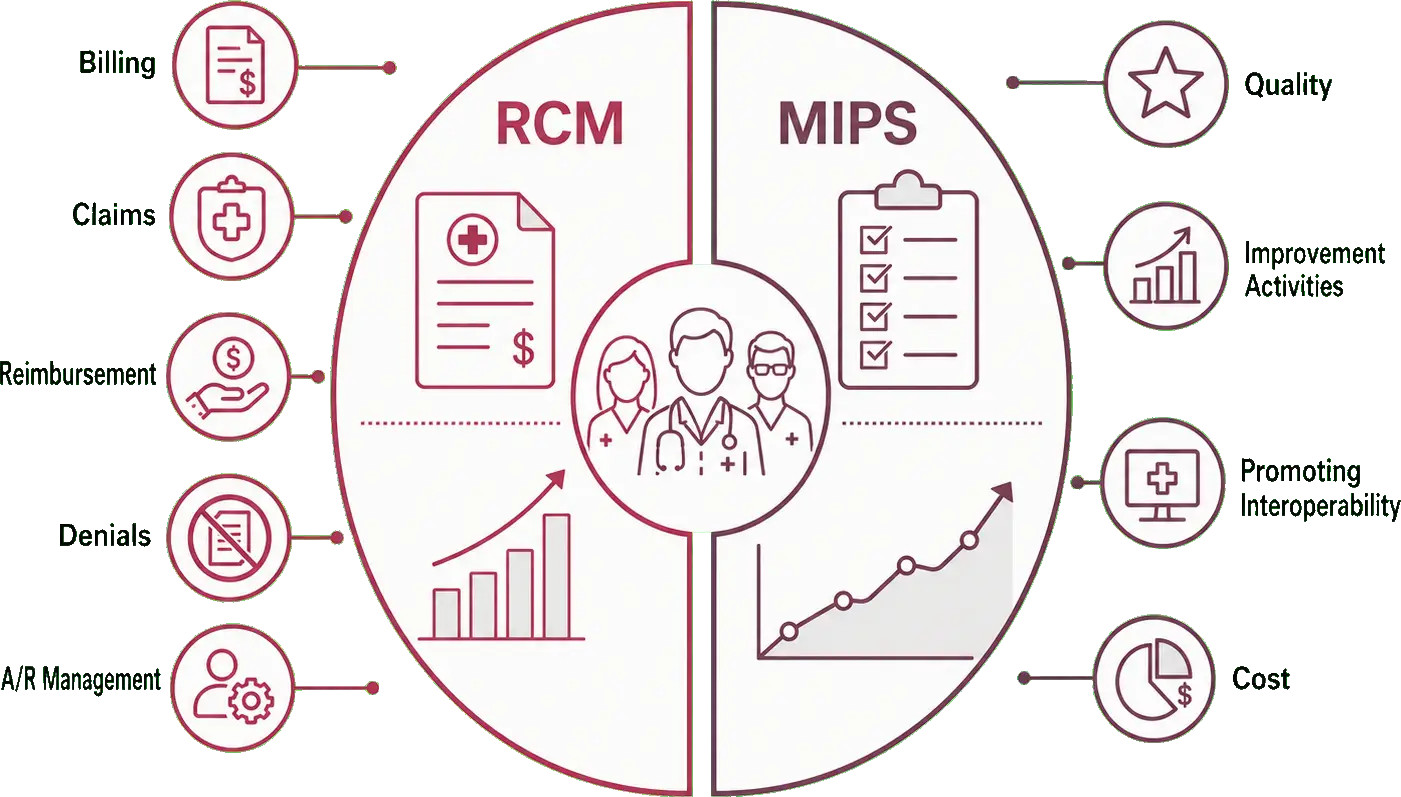
Revenue cycle management and MIPS address different areas of healthcare operations, but both can depend on accurate documentation, coding, workflows, and data.
Healthcare Revenues provides both RCM services and MIPS consulting, allowing healthcare organizations to address financial and quality-related processes through a coordinated strategy.
While RCM focuses on areas such as billing, claims, reimbursement, denials, and A/R, MIPS focuses on applicable performance requirements under CMS.
Effective RCM depends on accurate information moving between clinical, administrative, billing, and payer systems.
Healthcare Revenues can work with your existing technology environment and established workflows to support revenue cycle operations.
Depending on your practice, this may involve:
EHR systems
Clearinghouses
Eligibility transactions
Reporting platforms
Practice management systems
Electronic claims
Electronic remittance
Billing systems
The goal is to create a reliable workflow around your existing infrastructure rather than introducing unnecessary complexity.
RCM Performance Metrics
Measure What Matters
Effective revenue cycle management requires more than simply looking at total collections.
Healthcare organizations may monitor a range of operational and financial indicators, including:
A/R aging
Days in A/R
Clean claim performance
Denial rate
Claim rejection rate
Payment turnaround
Collection performance
Net collection performance
Outstanding claims
Payer performance
Underpayments
Patient balances
The right metrics depend on your organization, specialty, payer mix, billing model, and reporting objectives.
Healthcare Revenues can help establish reporting around the indicators that matter most to your revenue cycle.
Why Choose Healthcare Revenues for RCM?
More Than Medical Billing
Healthcare Revenues approaches RCM as an end-to-end process rather than simply a claims submission function.
Our broader healthcare service capabilities include:
Revenue Cycle Management
Medical Billing
Medical Coding
Medical Credentialing
Front Office Management
Payment Posting
Old A/R Cleanup
Chronic Care Management
MIPS Consulting
PCMH Consulting
HEDIS Consulting
Eligibility & Benefits Verification
Charge Entry & Claim Filing
A/R Management
Reporting & Compliance
Remote Patient Monitoring
This allows us to understand how individual revenue cycle functions connect with the broader operations of a healthcare organization.
Our objective is to help you build a more organized, measurable, and sustainable revenue cycle.
Frequently Asked Questions About RCM
What is Revenue Cycle Management in healthcare?
Revenue Cycle Management is the process of managing the financial lifecycle of a healthcare encounter, from patient registration and insurance verification through claim submission, reimbursement, payment posting, A/R follow-up, and final account resolution.
What does an RCM company do?
An RCM company provides services that support healthcare organizations with financial and administrative processes such as eligibility verification, charge entry, medical billing, claim submission, payment posting, denial management, A/R follow-up, and reporting.
Is RCM the same as medical billing?
No. Medical billing is one component of the broader revenue cycle.
RCM can include front-end activities such as registration and eligibility verification, as well as coding, billing, claims management, payment posting, denial management, A/R follow-up, and collections.
Why is revenue cycle management important?
Effective RCM helps healthcare organizations manage the financial side of patient care, reduce avoidable billing problems, improve visibility into outstanding revenue, and maintain more consistent payment workflows.
What are the main stages of the healthcare revenue cycle?
The revenue cycle can include patient registration, insurance verification, authorization, charge capture, coding, claim submission, payment processing, denial management, A/R follow-up, patient collections, and reporting.
The exact workflow varies by organization and healthcare setting.
How can RCM help reduce claim denials?
RCM can help reduce avoidable denials by addressing issues earlier in the process, such as incorrect patient information, eligibility problems, coding errors, missing information, and claim submission issues.
Denial analysis can also help identify recurring problems and improve upstream workflows.
What is A/R in medical billing?
A/R stands for Accounts Receivable. In healthcare, A/R generally represents outstanding amounts owed to a healthcare provider by insurance payers and/or patients.
What is denial management in RCM?
Denial management is the process of identifying, analyzing, correcting, appealing, and tracking denied claims while looking for recurring causes that can be addressed earlier in the revenue cycle.
Can Healthcare Revenues handle the complete revenue cycle?
Healthcare Revenues provides a broad range of RCM services covering front-end and back-end revenue cycle functions, including eligibility, charge entry, billing, claims, payment posting, denial management, A/R, and reporting.
Does Healthcare Revenues provide RCM for specialty practices?
Yes. Healthcare Revenues provides RCM support for healthcare organizations across multiple specialties and can tailor workflows according to specialty-specific billing and operational requirements.
Can RCM services be customized?
Yes. Revenue cycle requirements vary by organization. Services can be structured around your specialty, practice size, payer mix, technology, staffing model, existing workflows, and specific revenue cycle challenges.
How do I know if my practice needs RCM support?
Signs that your practice may benefit from additional RCM support can include growing A/R, recurring denials, delayed payments, inconsistent billing workflows, limited reporting visibility, missed charges, or excessive administrative workload.
A revenue cycle assessment can help identify where the main issues are occurring.
Take Control of Your
Revenue Cycle
Your revenue cycle should work as a connected process — from the first patient interaction to the final payment.
Healthcare Revenues provides comprehensive RCM support to help healthcare organizations manage billing, claims, payments, denials, A/R, and reporting with greater consistency and visibility.
Whether you need complete revenue cycle support or help with a specific part of your billing operation, we can build an approach around your organization’s needs.
Stop letting preventable revenue cycle issues slow down your practice.