
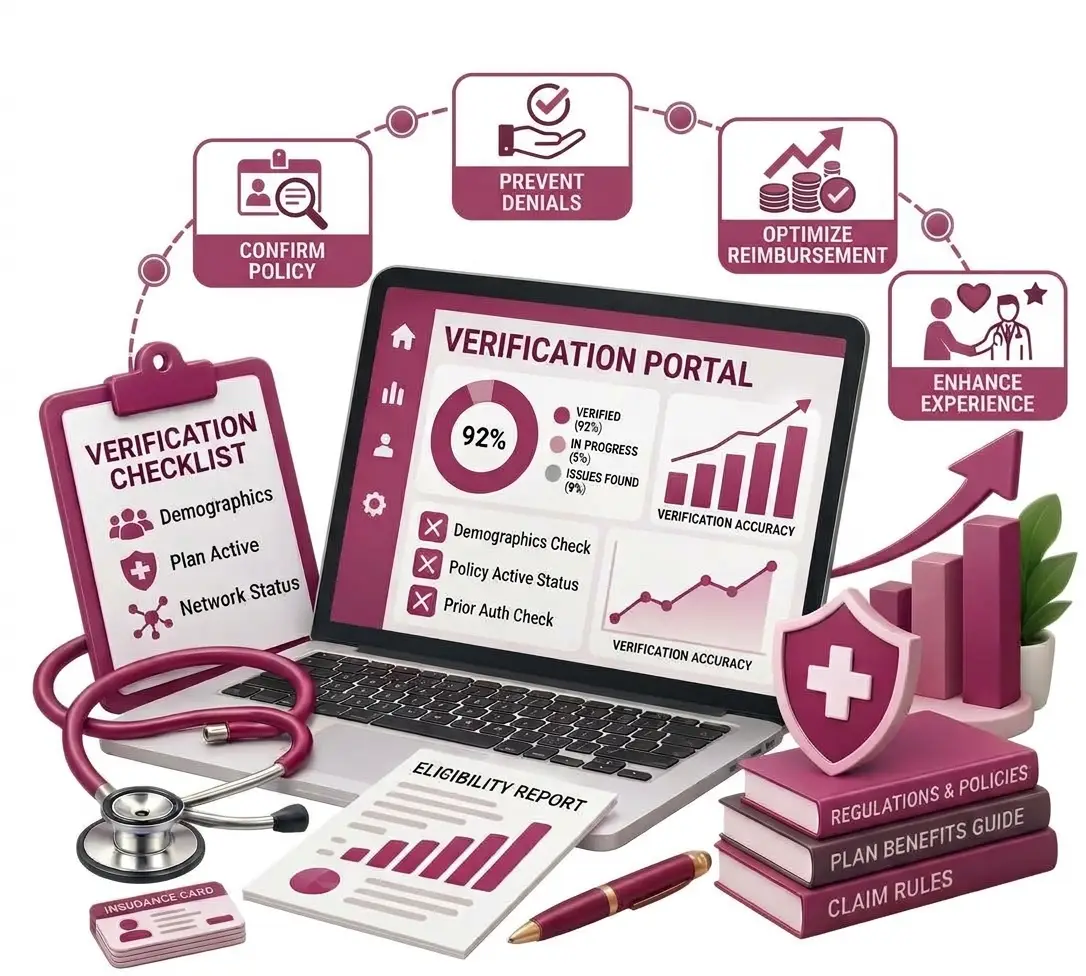
Insurance eligibility and benefits verification is an important part of the healthcare revenue cycle. Before providing services, healthcare organizations need accurate information about a patient’s insurance coverage, benefits, financial responsibility, and applicable payer requirements.
Healthcare Revenues provides eligibility and benefits verification services for physicians, medical practices, specialty practices, clinics, hospitals, and healthcare organizations across the United States.
Our team reviews available insurance information to verify coverage and benefits before scheduled services. This may include eligibility status, coverage dates, deductibles, copayments, coinsurance, out-of-pocket information, referral requirements, authorization requireme
Insurance eligibility and benefits verification is the process of checking a patient’s health insurance information to determine whether coverage is active and what benefits and financial responsibilities apply to the planned healthcare services.
The verification process may review information such as:
Eligibility verification does not guarantee claim payment. Final claim determination remains subject to the patient’s plan, payer policies, medical necessity requirements, authorization requirements, coding, documentation, provider participation, and other applicable conditions.
Insurance information can change between patient visits. A patient who had active coverage previously may have a different plan, changed employers, reached a deductible threshold, or no longer have active coverage.
Without timely verification, a practice may encounter issues such as:
Patient Scheduling → Registration → Eligibility Verification → Benefits Review → Authorization/Referral → Patient Visit → Coding → Claim Submission → Payment
Verification occurs early in the revenue cycle and provides information that may affect later billing and claims processes.
The required patient and insurance information is provided through the practice's established workflow.

We review the available information to identify the applicable payer, plan, member information, and date of service.
Eligibility is checked through the applicable payer or verification system.

Supporting quality initiatives related to cardiovascular risk and disease management. Available benefits and financial responsibility information are reviewed based on the service and payer response.

Referral, authorization, provider participation, or other applicable requirements are identified when available.

Relevant information is documented according to the agreed workflow so it is available to the appropriate practice staff.
Potential coverage discrepancies, missing information, or other issues requiring additional attention are identified for follow-up.

Verified information is made available to the appropriate team before the patient's scheduled service, based on the established practice workflow.

Verifying insurance before the appointment gives the practice an opportunity to identify potential issues before the patient receives services.
For example:
Active Coverage
→ Confirm applicable benefits
→ Review patient responsibility
→ Proceed with scheduled service
Inactive Coverage
→ Identify coverage issue
→ Contact patient or update insurance information
→ Reduce avoidable billing problems
Authorization Required
→ Identify requirement
→ Begin applicable authorization process
→ Reduce the risk of an administrative issue after the visit
Incorrect Insurance Information
→ Identify discrepancy
→ Obtain updated information
→ Submit billing information using the appropriate payer details
The goal is not to guarantee payment. The goal is to provide the practice with relevant insurance information before the encounter so appropriate administrative decisions can be made.
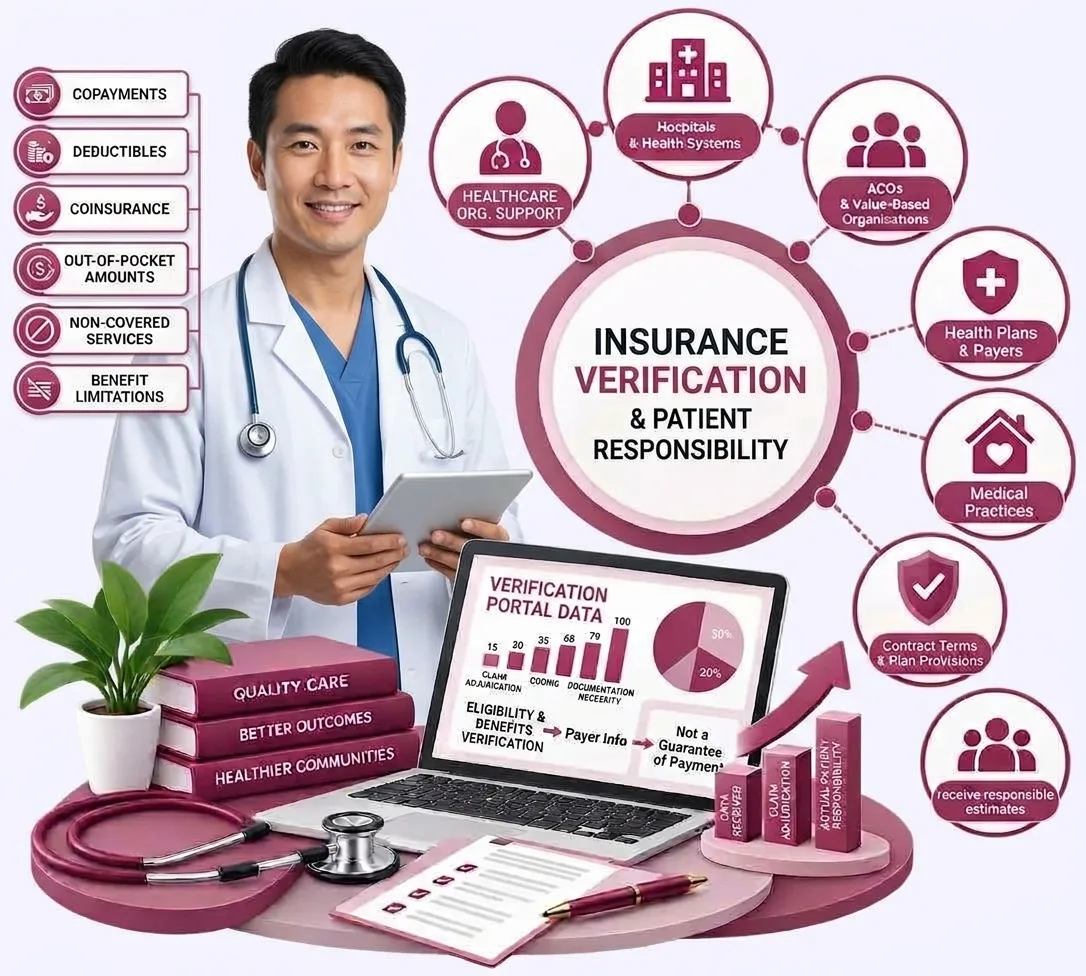
Patients may have financial responsibility based on their specific insurance plan and the services they receive.
Depending on the plan, this may include:
Eligibility and benefits verification helps the practice obtain available information about these areas.
However, benefit information received from a payer is not the same as a guarantee of payment. Actual patient responsibility may depend on claim adjudication, coding, documentation, medical necessity, contract terms, plan provisions, and other factors.
Eligibility verification is one of the earliest revenue cycle activities performed before a patient encounter.
The relationship can be represented as:
Patient Information → Insurance Verification → Eligibility & Benefits → Authorization → Patient Visit → Coding → Charge Entry → Claim Filing → Payment Posting → A/R
Problems at the eligibility stage may create downstream billing and claims issues.
For example:
Incorrect Payer Information
→ Claim submitted to wrong payer
→ Claim processing issue
→ Additional billing work
Inactive Coverage
→ Services provided without current coverage information
→ Potential patient balance
→ Additional collection activity
Missing Authorization
→ Required authorization not obtained
→ Potential claim issue
→ Additional administrative work
This is why eligibility verification is an important component of an organized revenue cycle.
Healthcare Revenues also provides:
Healthcare Revenues provides eligibility and benefits verification support for different healthcare settings.
Support for practices that need reliable insurance verification without placing the entire workload on internal staff.
Support for ongoing patient eligibility and benefits verification across scheduled appointments.
Support for specialty-specific insurance verification requirements and services.
Support for multiple providers, schedules, and payer requirements.
Support for higher patient volumes and more extensive front-office workflows.
Support for organizations managing large patient populations and multiple administrative processes.
Both new and established patients may require insurance verification.
New patients may provide insurance information during registration. Verification helps confirm available coverage and benefits before the initial appointment.
Existing patients may have changed insurance coverage since their previous visit. Their eligibility and benefits may therefore need to be verified again.
Even when the patient’s insurance information has not changed, coverage status and benefit information may change over time.
For this reason, practices should establish a verification schedule appropriate for their patient volume, payer mix, services, and workflow.
For this reason, practices should establish a verification schedule appropriate for their patient volume, payer mix, services, and workflow. Regular verification helps ensure that eligibility information remains current and gives staff an opportunity to identify changes before or around the time services are provided.
Healthcare Revenues’ eligibility and benefits verification services help practices manage:
The specific verification process depends on the practice, payer, services, systems, and information available at the time of verification.
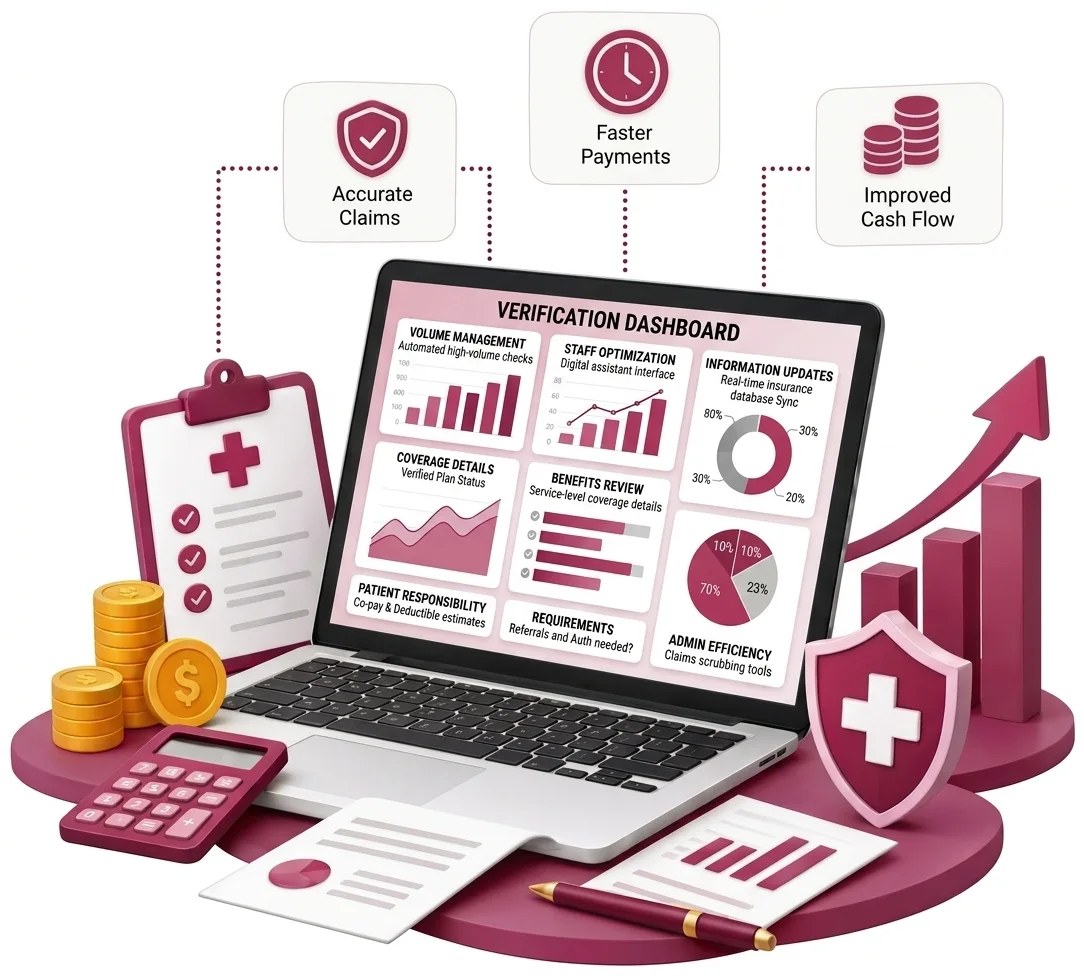
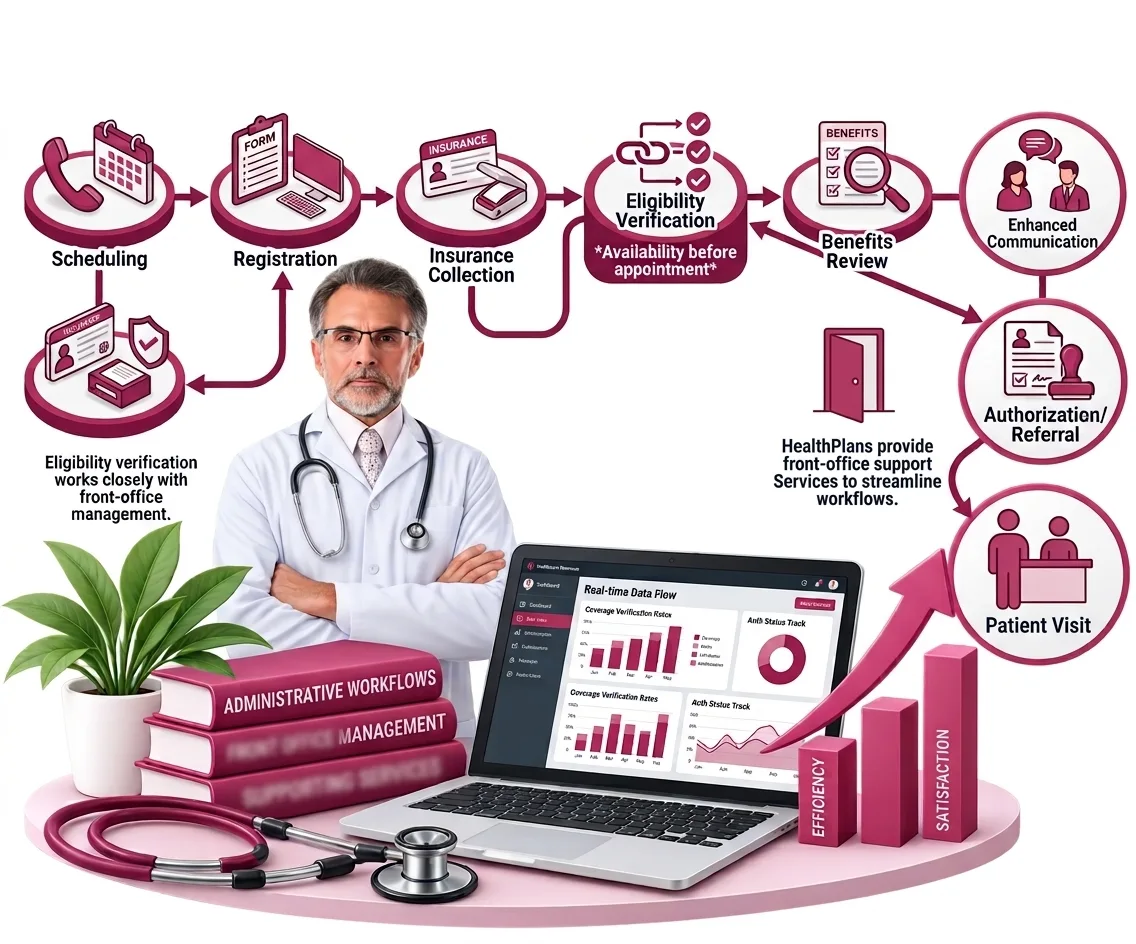
Eligibility verification works closely with front-office management.
A typical workflow is:
Scheduling → Registration → Insurance Collection → Eligibility Verification → Benefits Review → Authorization/Referral → Patient Visit
When eligibility information is available before the appointment, front-office staff have more information for handling registration, patient communication, and pre-visit administrative requirements.
Healthcare Revenues also provides Front Office Management Services to support related administrative workflows.
Healthcare Revenues provides eligibility and benefits verification services for:
Our services support organizations across the United States and work alongside broader billing, RCM, and front-office processes.
Healthcare Revenues brings approximately 15 years of healthcare industry experience to its work with healthcare organizations.
Our approach is results-oriented. We focus on the work that needs to be completed, communicate clearly about the services being provided, and deliver what we commit to.
Eligibility and benefits verification is also connected to front-office operations, medical billing, claims, and the broader revenue cycle. Our broader healthcare service portfolio allows these functions to work together when required.

HEDIS consulting provides professional support for healthcare organizations that need help with HEDIS measures, data collection, medical record review, care gap identification, patient outreach, reporting, and quality improvement.
HEDIS stands for Healthcare Effectiveness Data and Information Set.
HEDIS measures are standardized healthcare performance measures used to evaluate different aspects of healthcare quality and effectiveness.
HEDIS measures are widely used across healthcare quality programs, particularly by health plans and organizations involved in quality measurement and performance improvement.
HEDIS covers numerous areas of healthcare quality, which can include preventive care, chronic disease management, behavioral health, medication management, women’s health, children’s health, and other quality areas.
A HEDIS care gap represents an opportunity where an eligible patient may not have received a required or recommended service associated with an applicable quality measure.
For example, a patient may be identified as needing a preventive screening or follow-up service.
Care gap closure can involve patient identification, outreach, appointment scheduling, care coordination, provider intervention, documentation, and follow-up.
The specific approach depends on the applicable measure and patient population.
HEDIS medical record review involves examining patient records for clinical information and documentation relevant to applicable quality measures.
Medical record review can help identify evidence of care that may not be available through other data sources.
Professional consulting cannot guarantee a specific HEDIS score. However, structured quality management, accurate data collection, effective care gap identification, patient outreach, and performance improvement processes can help organizations address opportunities that affect applicable measures.
Accurate insurance information is important before the patient visit. Healthcare Revenues provides eligibility and benefits verification support to help your organization review coverage, benefits, patient responsibility, and applicable payer requirements before services are provided.
Our support can help your team identify coverage information early and maintain a more organized verification process before the patient receives services.
Our verification support can also help reduce avoidable delays caused by incomplete or outdated insurance information.