
Payment posting is the process of recording payments, contractual adjustments, patient responsibility, and other remittance information in a healthcare organization’s billing system after a claim has been processed.
Accurate posting is important because the information recorded at this stage affects patient balances, accounts receivable, reconciliation, denial follow-up, and revenue cycle reporting.
Healthcare Revenues provides payment posting services for physicians, medical practices, specialty practices, clinics, hospitals, and healthcare organizations across the United States.
Our team posts insurance payments, electronic remittance information, patient payments, contractual adjustments, and other applicable transactions according to the organization’s billing workflow. We also identify discrepancies and payment-related issues that require additional review.
Payment posting is a revenue-cycle process that begins after a payer or patient makes a payment. When a payer processes a claim, the resulting remittance information explains how the claim was adjudicated. This may include:
The payment posting process records the applicable information in the practice management or billing system.
A simplified workflow is:
Claim Submission → Payer Adjudication → ERA/EOB → Payment Posting → Reconciliation → A/R Follow-Up
Payment posting therefore does more than record a check or electronic payment. It helps translate the payer’s response into financial information that the practice uses to manage individual accounts and its broader revenue cycle.
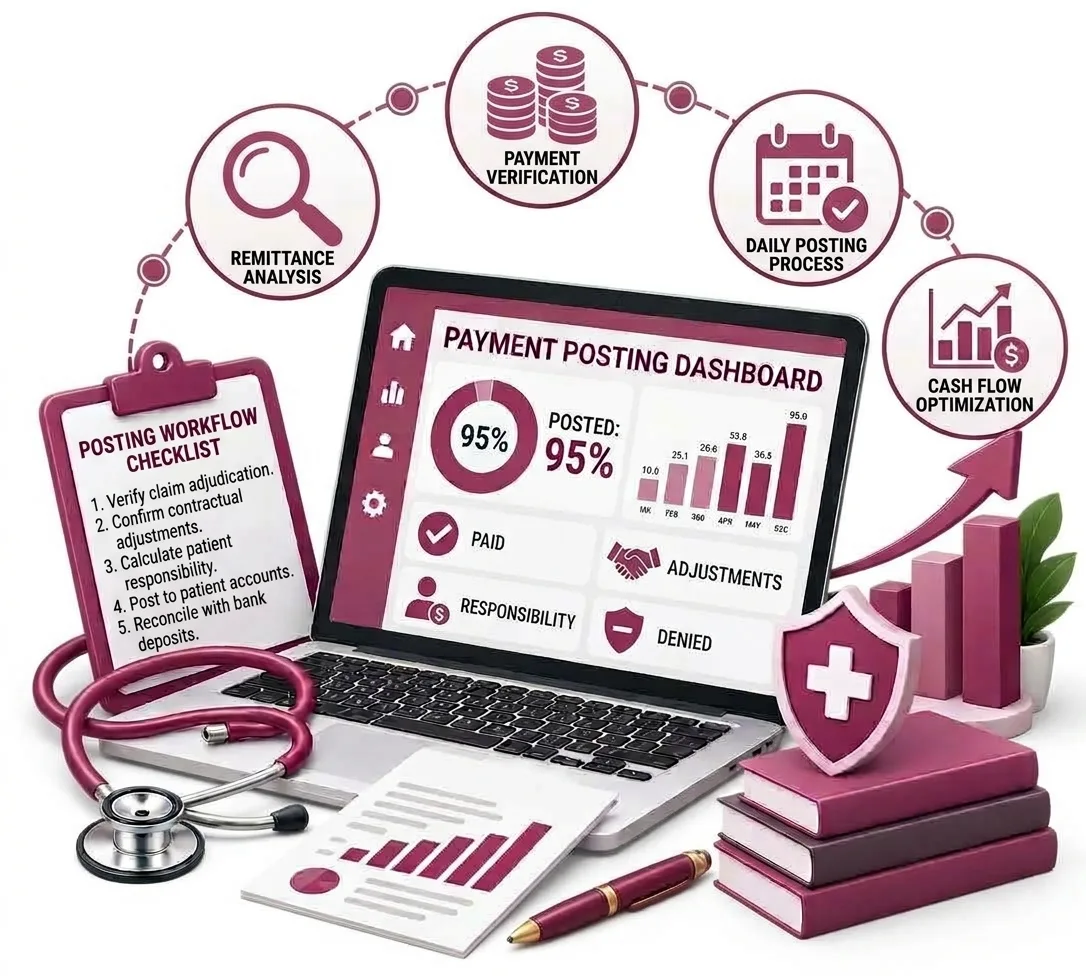
Healthcare organizations commonly receive payment information through Electronic Remittance Advice (ERA) and Explanation of Benefits (EOB) documents.
Electronic Remittance Advice (ERA)
An ERA is an electronic document sent by a payer that provides information about how submitted claims were processed.
Depending on the payer and transaction, an ERA may contain information about:
An EOB provides information about how an insurance claim was processed and what amounts were paid, adjusted, or assigned to patient responsibility.
Payment posting uses the information available from the ERA, EOB, payer portal, or other payment documentation to update the appropriate patient and account records.
A typical payment posting process involves several related activities. Payments are matched to the correct accounts, invoices, or claims, and the amounts received are recorded in the billing system. The team reviews supporting payment details, applies any relevant adjustments, and updates outstanding balances. Any discrepancies, such as partial payments, missing information, or incorrect amounts, are flagged for follow-up.

Insurance payments are posted to the appropriate patient and claim accounts based on the payer's remittance information.

Electronic remittance information is reviewed and applicable payment, adjustment, and patient-responsibility information is posted according to the established workflow.

EOB information is reviewed and posted to the appropriate account when payment information is received through paper or electronic documentation.
Patient payments received through applicable payment channels are posted to the appropriate accounts.

Applicable contractual adjustments are recorded based on payer remittance information and the organization's established billing process.
Deductibles, copayments, coinsurance, and other applicable patient responsibility amounts are recorded based on available payer information.
Payment posting may identify claims that were denied, partially paid, adjusted, or otherwise require additional billing or A/R attention.
Posted payments are reviewed against available payment records to identify discrepancies or transactions requiring further investigation.


Payment posting affects the financial information stored in the practice’s billing system.
An incorrect posting may create problems such as:
For example:
Payer Payment → Correct Posting → Correct Adjustment → Correct Patient Responsibility → Accurate A/R
If the payment or adjustment is posted incorrectly, the account balance may not accurately reflect what the payer has already paid or what remains outstanding.
Accurate payment posting therefore supports both financial accuracy and downstream A/R management.
Payment posting and A/R management are closely connected.
After a claim is adjudicated and payment is posted, the remaining account balance must be accurately identified.
A simplified workflow is:
Claim → Adjudication → Payment → Adjustment → Patient Responsibility → Remaining A/R → Follow-Up
Billed Amount → Payer Payment + Contractual Adjustment → $0 Remaining Balance
Billed Amount → Payer Payment + Adjustment → Remaining Balance → A/R Follow-Up
Claim → Denial → No or Reduced Payment → A/R / Denial Management
Payer Adjudication → Patient Responsibility → Patient Balance → Patient Billing
Correct payment posting helps ensure that these different outcomes are reflected accurately in the billing system.
Healthcare Revenues also provides Accounts Receivable Management Services for downstream account follow-up and collection activities.
Payment posting is not simply about entering the amount received.
The remittance information may reveal situations that require additional attention, including:
These issues may require additional review against payer contracts, claim information, remittance details, or other available records.
When a discrepancy requires further action, it may be routed to the appropriate billing, denial management, or A/R workflow.


Payment posting often provides the first clear indication that a submitted claim was not paid as expected.
For example:
Claim Submitted → Payer Adjudication → Remittance → Denial Identified → Denial Review → Corrective Action → Resubmission/Appeal
Denial information recorded during payment posting may include payer reason codes, remark codes, or other available information explaining the payer’s decision.
Accurate identification and documentation of these issues helps move the account into the appropriate follow-up process.
Healthcare Revenues’ broader Revenue Cycle Management Services connect payment posting with denial, A/R, and other downstream revenue-cycle activities.
After payer adjudication, part of the allowed or billed amount may be assigned to the patient.
This may include:
Accurate posting helps ensure that the patient account reflects the amount identified by the payer’s remittance information.
Patient responsibility should not be confused with a guaranteed final amount in every situation. The patient’s actual balance may depend on claim adjudication, payer information, contractual arrangements, corrections, secondary insurance, and subsequent account activity.


Payment information contributes to the financial data used for revenue cycle reporting.
Accurate posting supports visibility into:
If payment information is incomplete or inaccurate, reports generated from the billing system may also fail to accurately represent the organization’s financial position.
Healthcare Revenues also provides Reporting & Compliance Services to support broader revenue cycle reporting requirements.









Healthcare organizations may outsource payment posting when internal teams face high transaction volumes, staffing limitations, or posting backlogs.
Common reasons include:
Outsourcing provides additional operational support while allowing the practice to maintain oversight of its billing systems, payer relationships, and financial processes.
Payment posting does not operate independently.
It connects several stages of the healthcare revenue cycle:
Patient Registration → Eligibility & Benefits Verification → Patient Encounter → Medical Coding → Charge Entry & Claim Filing → Payer Adjudication → Payment Posting → A/R Management → Denial & Payment Follow-Up → Collections
This position makes payment posting an important bridge between payer adjudication and the practice’s financial records.
Healthcare Revenues provides services across this workflow, including:
Healthcare Revenues provides payment posting services for:
Payment posting workflows vary by organization, payer mix, billing system, payment volume, and internal processes.

Healthcare Revenues brings approximately 15 years of healthcare industry experience to its work with U.S. healthcare organizations.
Our approach is results-oriented. We focus on the work that needs to be completed, communicate clearly about the services being provided, and deliver what we commit to.
Because payment posting is connected to A/R, denials, billing, reconciliation, and revenue cycle reporting, it should be managed as part of the broader financial workflow rather than as an isolated data-entry task.

Payment posting is the process of recording insurance payments, patient payments, contractual adjustments, patient responsibility, and other applicable remittance information in the healthcare billing system.
ERA payment posting involves reviewing an Electronic Remittance Advice and recording the applicable payment, adjustment, patient responsibility, denial, and other remittance information in the billing system.
Yes. Patient payments received through applicable payment channels may be posted to the appropriate patient accounts.
Payment posting may identify denied or partially paid claims through the remittance information. Those accounts may then move into the appropriate denial or A/R workflow.
Yes. Payment Posting is available as an individual service and as part of Healthcare Revenues’ broader Revenue Cycle Management services.
Accurate payment posting helps your practice know what was paid, what was adjusted, what remains the patient’s responsibility, and which accounts require additional attention.
Healthcare Revenues provides insurance payment posting, ERA/EOB posting, patient payment posting, adjustment posting, reconciliation, and payment-related issue identification for U.S. healthcare organizations.